Crankenstein
A downloadable game
A physically simulated engine. Nothing sampled, nothing looped.
About
Most engine sounds in games are recordings. A handful of takes at a handful of revs, pitch-shifted and crossfaded to cover the gaps. It works until you listen closely, and then it never stops sounding like a recording being stretched.
Crankenstein has no recordings in it.
It solves the pressure inside every cylinder at every crank angle and lets that pressure escape down a simulated exhaust built from bidirectional delay lines. What reaches your speakers is the pressure wave arriving at the end of the tailpipe. Lengthen the header and the note changes, because the wave takes longer to come back. Change the firing order and the character changes, because the pulses arrive in a different rhythm.
Nobody told it what a V8 should sound like. It sounds like that because of how it is built.
What you do
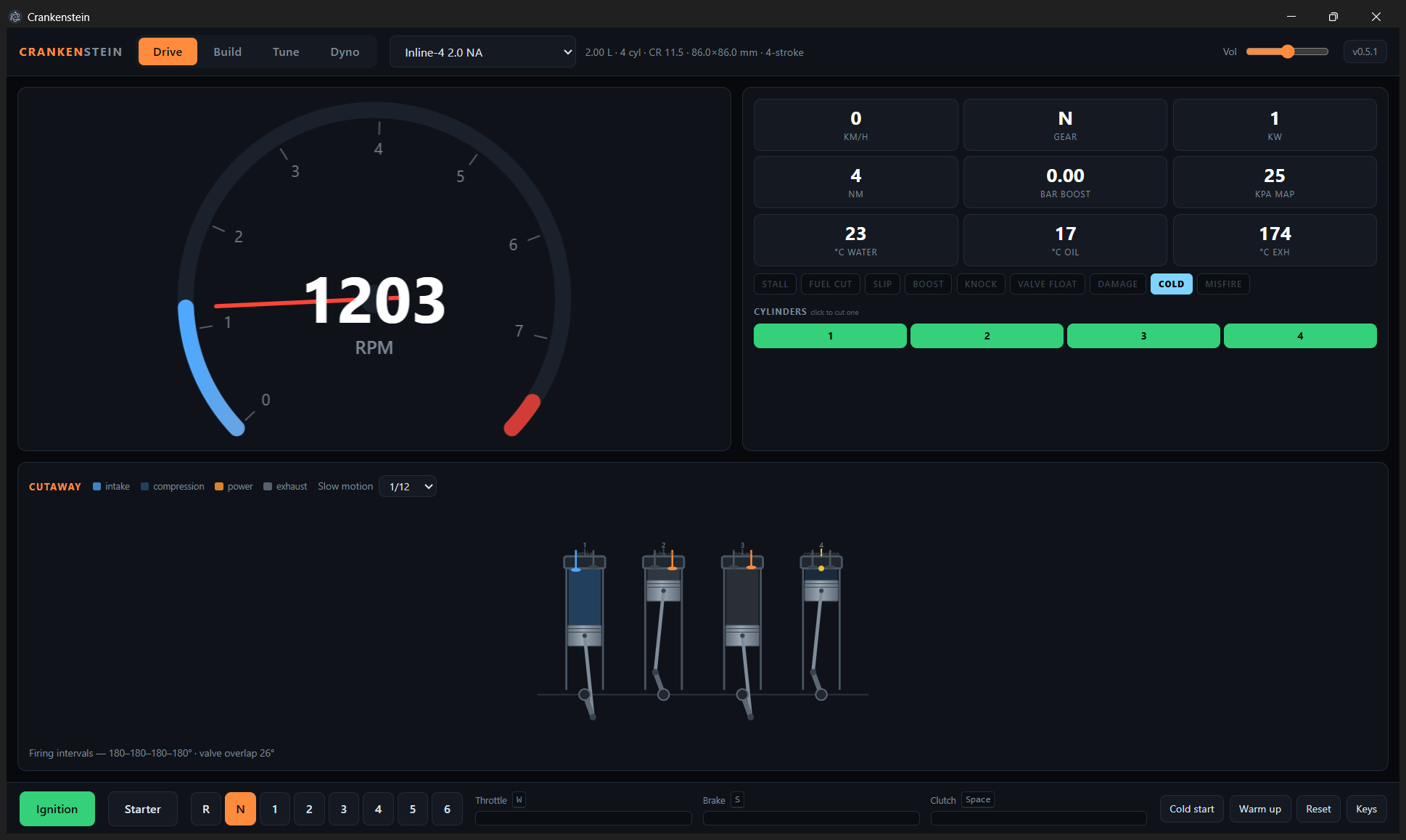
Drive seventeen engines — from a 212 cc kart single to a 6.7-litre turbodiesel. Inline fours, a flat-plane and a cross-plane V8, a V10, a V12, boxers, a V-twin, and two real karts: the IAME X30 two-stroke and the Torini Clubmaxx.
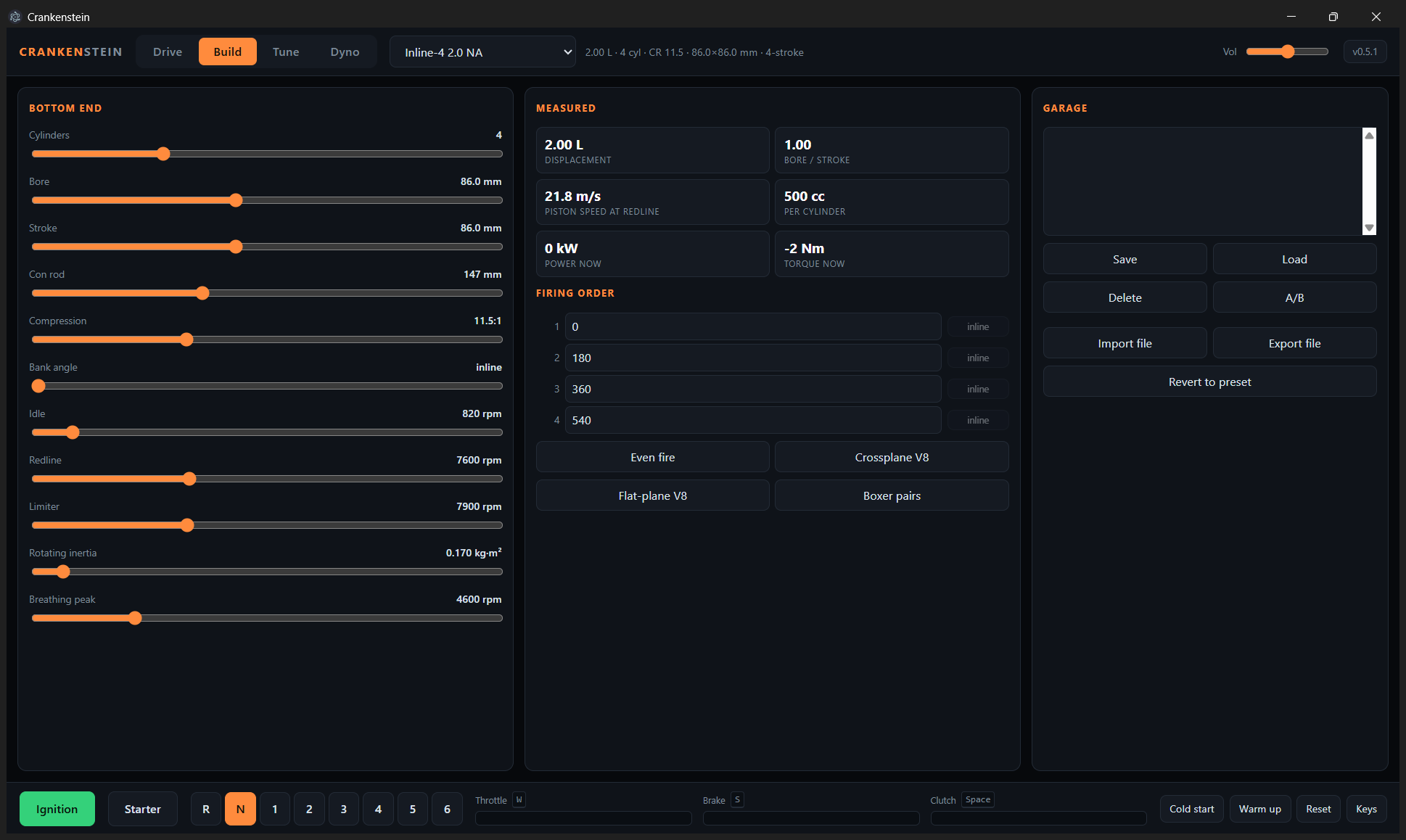
Build your own. Bore, stroke, rod length, compression, bank angle, cylinder count, rotating inertia — and a firing order editor where you place each cylinder's crank angle by hand. A big-bang twin and a screaming flat-plane eight come out of the same sliders.
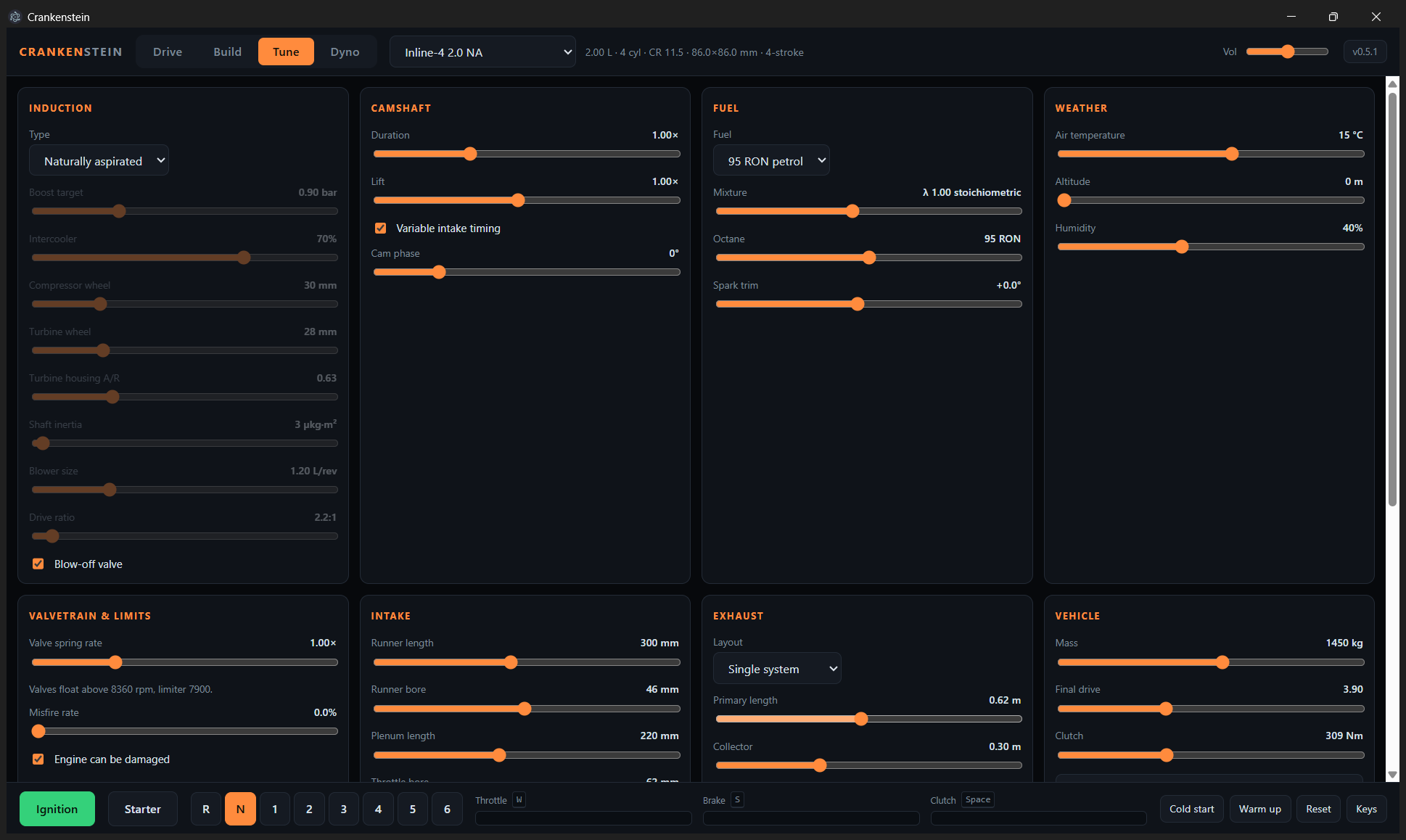
Tune it by ear. Runner lengths, plenum volume, throttle bore, primary and collector lengths, silencer chambers. Cam duration, lift and variable timing. Nothing is a lookup table: move a runner and the resonance moves with it.
Bolt on boost. Turbocharger, Roots blower or centrifugal — compressor and turbine wheels, housing A/R, shaft inertia, wastegate, intercooler, blow-off. The turbo spools on exhaust energy and is paid for in backpressure, so it lags because lagging is what it does.
Break it. Wind the boost up on cheap fuel and it detonates; hold it there and you lose cylinders one by one. Raise the limiter past what the valve springs can follow and the valves float. Damage is permanent until you rebuild.
Take it up a mountain. Altitude, temperature and humidity are real inputs. A naturally aspirated V8 loses about a quarter of its power at 2000 m. The turbo loses noticeably less, because its wastegate simply stays shut for longer — an answer the simulation reaches on its own.
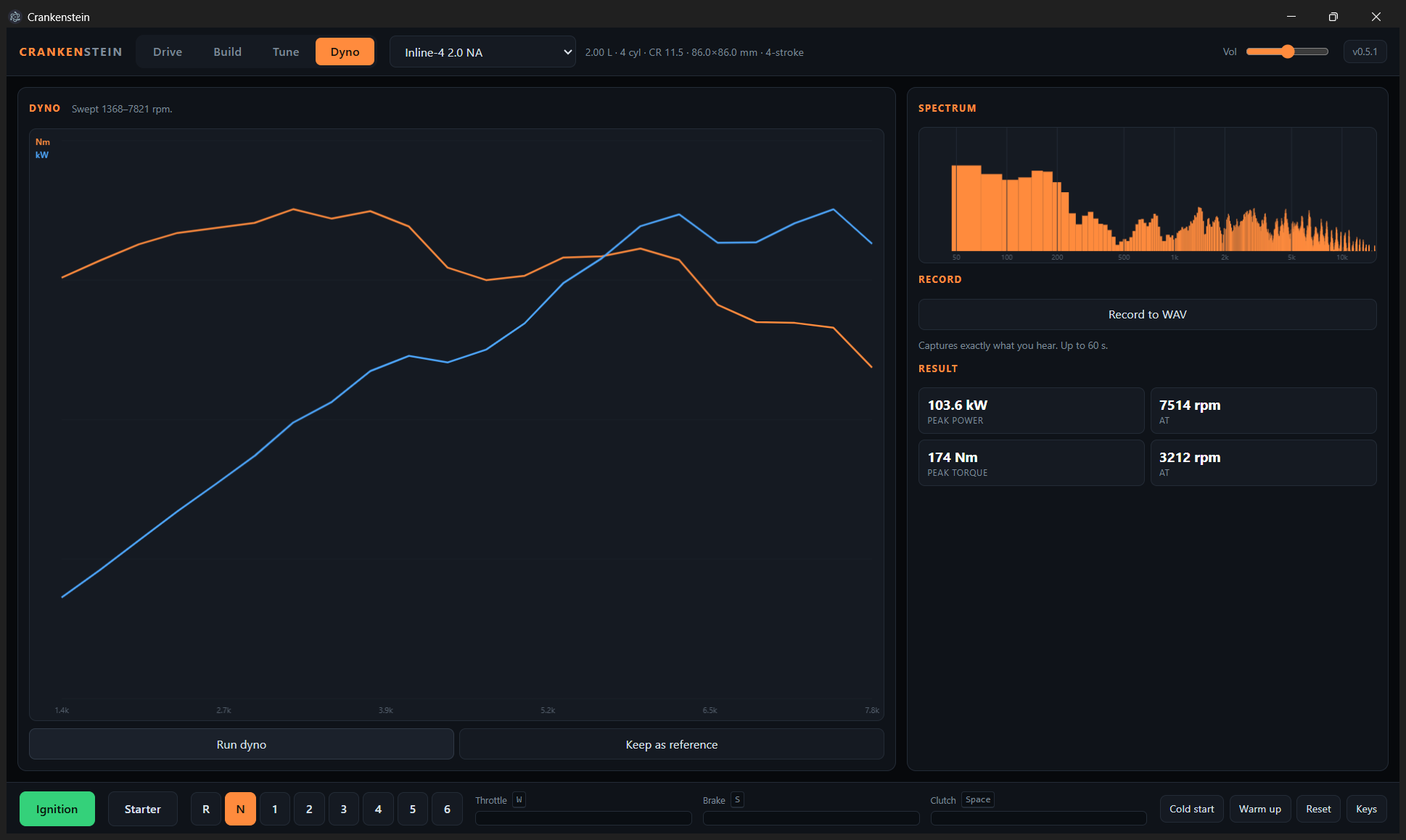
Measure everything. A dyno that sweeps a copy of your engine while the one you are driving keeps running, and holds the previous curve on screen so you can see exactly what a change bought. A live spectrum. A recorder that captures what you are hearing to a WAV.
Under the bonnet
- Cylinder pressure from slider-crank volume, polytropic compression and Wiebe heat release, over 4096 crank positions per cycle
- Valve flow solved as a compressible orifice against the pipe's own impedance
- Exhaust and intake as digital waveguides — delay lines, scattering junctions, expansion chambers, collectors, X-pipes, open-end radiation
- Volumetric efficiency is not a table; it is whatever the engine actually traps
- Knock as a Livengood–Wu induction integral, ringing the bore's first circumferential mode
- Diesels burn in two stages — ignition delay, premixed spike, diffusion burn — with the clatter driven by rate of pressure rise per crank degree
- Two-strokes get a crankcase pump, reed valve, piston-uncovered ports and an expansion chamber whose returning wave genuinely supercharges the cylinder
- Per-cylinder manufacturing scatter, so the firing pattern is never perfectly periodic
None of it is decorative. The X30's trapped compression ratio of 8:1 emerges from its port timing having only been given the 15:1 geometric figure — which is what the real engine measures. The Torini Clubmaxx makes 15.1 Nm and 7.30 kW at the speeds its manufacturer quotes 15 Nm and 7.4 kW: within about one percent, from geometry rather than from tuning to the answer.
Every engine is checked by an automated harness on every change — 517 figures covering idle speeds, torque, volumetric efficiency, peak cylinder pressure, boost and the spectral balance of the sound itself.
Install
Windows — download, unzip, run. Windows will show "Windows protected your PC" because the build is not code-signed (a certificate costs more per year than this project has ever earned). Click More info → Run anyway.
Linux — extract the tarball and run ./crankenstein.
No macOS build yet.
Requirements
Windows 10+ or Linux, 64-bit. Any dual-core machine from the last decade — it is arithmetic, not graphics. Headphones recommended: a good deal of what separates a cross-plane V8 from a flat-plane one lives below 100 Hz.
Crankenstein is a simulator, not a driving game. There is no track, no lap time and no car — only the engine, a clutch, a gearbox, and whatever you decide to build.
Download
Install instructions
Simply run the setup exe and your good to go!
Leave a comment
Log in with itch.io to leave a comment.